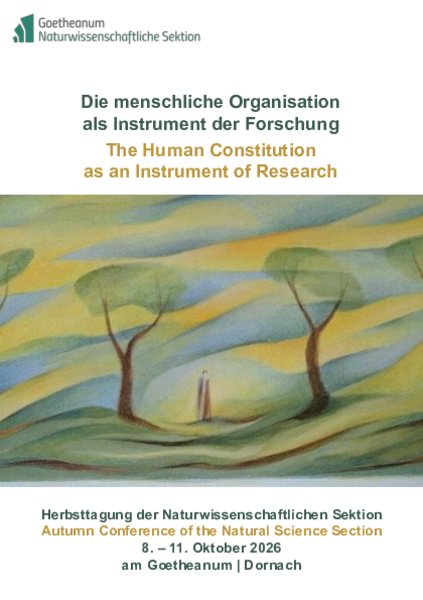
The Human Constitution
as an Instrument of Research
Autumn Conference of the
Natural Science Section
at the Goetheanum – at the Halde Saal
October 8 – 11, 2026
The human being is a wonder, with a multifaceted and comprehensive capacity for approaching nature not just through the physical body but through the etheric and soul-spiritual organisation as well. Levels of cognition thereby become accessible to the human that remain closed to artificial intelligence.
In his introduction to Goethe’s scientific writings, Rudolf Steiner describes how the human being feels an urge to explore the world out of an inner need of the soul. However, over the course of the modern era, research became increasingly detached from human sensory perception, and thinking became more abstract. Researchers sought an “objective” external viewpoint and gradually excluded inner, soul-based experience. So, although science brought tremendous progress and new technologies, these advances in knowledge distanced us from the forces of nature. But are we not part of nature? Have we therefore lost touch with ourselves? Is there an approach, a method, that could reconnect us with the meaning of life? The Goethean-anthroposophical approach to research proposes, as a first step, that we consciously turn our attention towards the organization of our own senses.
The child initially develops a relationship to their physical body through their sense of life, balance, self-movement, and touch. As their hands become free, they begin to “grasp” the world: their sense of warmth, sight, smell, and taste unfold a rich world of sensations and feelings. Finally, the child learns to engage their sense of hearing, speech, concept, and the ‘I’, which form the basis for thinking. The development of self-awareness arises simultaneously with the awareness of the world.
What develops unconsciously for the child is what Goethe considered the model for the scientist, who ought to esteem and use the senses consciously. In addition to this, can we develop other senses that, like Goethe’s “intuitive power of judgment” (anschauende Urteilskraft), go beyond intellectual thinking?
If we follow the growth of a plant through time, we can inwardly participate in its lawful dynamic. By training our thinking using the imaginal qualities of nature, we can recreate from many observations an inner formative image of the living plant. Is this what is meant by the “imaginative consciousness” through which we experience plant vitality with our etheric organisation? Is it possible to experience the inner side of nature through this spiritual activity in our soul?
We are part of the world when our senses are allowed to unfold their capacities in body, soul, and spirit. Then the world comes alive in our consciousness not only in what it has become but also in its process of becoming.
We warmly invite you to join us at this year’s Autumn Conference of the Natural Science Section, from October 8 to 11, 2026, to engage in dialogue on these questions and to contribute with your perspectives, work, and research presentations.
Vesna Forštnerič Lesjak, Matthias Rang
& the Team ofthe Natural Science Section
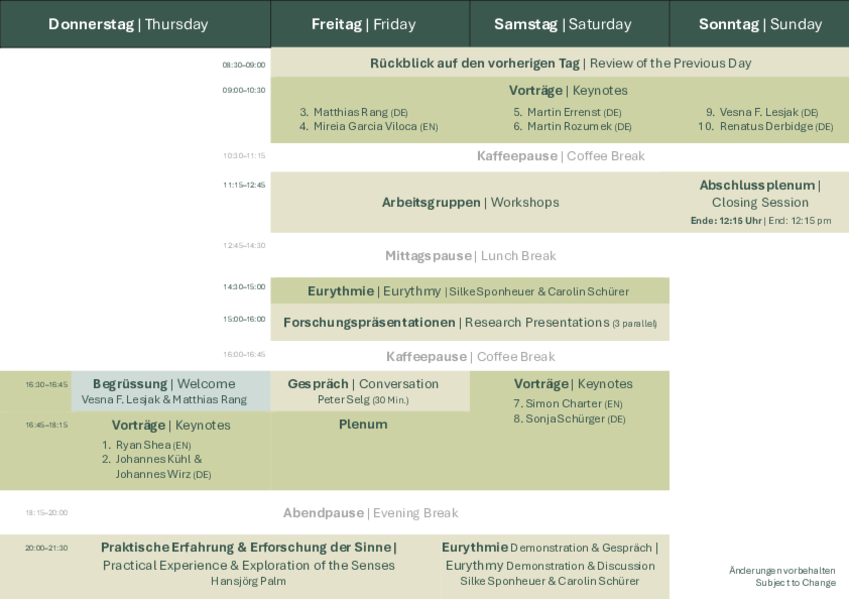
Format:
- There will again be research presentations (15-minute presentation and 5-minute discussion).
- The conference is intended for German- and English-speaking participants
- If participation is not possible for financial reasons, please feel free to get in touch with us:
science@goetheanum.ch
Meals:
Lunches and evening meals are not included.
For lunch, you may purchase something small in the Wandelhalle or at the Vital Shop (at your own expense).
For dinner, it is best to bring something with you, as neither the Wandelhalle, the Speisehaus, nor the Vital Shop will be open at that time.
Please note that the Speisehaus will be closed throughout the entire event.
Fees:
Conference ticket:
(without lunch or evening meals)
Regular price: CHF 280.00
Reduced price: CHF 160.00
Single keynote ticket:
Regular price: CHF 24.00
Reduced price: CHF 16.00
Full-time researcher and educator at The Nature Institute in Ghent, New York and a doctoral researcher in MESH (Multidisciplinary Environmental Studies in the Humanities) at the University of Cologne, Germany. Taught environmental philosophy, philosophy of science, interdisciplinary humanities, and nature writing at Providence College for eight years. Current research focuses on developing the practice of phenomenological ecology, with particular attention to plants and insects. Editor of The Nature Institute’s in-house publication In Context and co-producer of their podcast In Dialogue with Nature. Recently co-edited with Craig Holdrege a new translation of Andreas Suchantke’s book Insect Forms and Patterns: Exploring the Language of Nature (2025).
Owen Barfield and an Ecology of Participatory Consciousness
The 20th century philologist and anthroposophist Owen Barfield researched the phenomenon of language not only as a way to understand everyday human experience as it now happens to be, but also as a pathway for cultivating a living imaginative consciousness that he called “final participation.” This talk explores Barfield’s language-focused phenomenology of the human being in relation to my own ethological research into insects and my morphological research into plants. I will indicate first steps in a phenomenological ecology that is capacious enough to include human participatory consciousness.
Johannes Kühl: Born in 1953 in Hamburg (Germany). After attending a Waldorf school and completing civil service in agriculture, studies in physics, mathematics and chemistry in Hamburg and Göttingen. Diploma thesis at the Max Planck Institute for Flow Research under Ernst-August Müller. Subsequently scientific collaborator at the Natural Science Section at the Goetheanum in Dornach, Switzerland. From 1982 to 1996 upper school teacher at the Waldorf School Stuttgart Uhlandshöhe. Since 1982 member of the collegium of the Natural Science Section at the Goetheanum, and since 1996 its head. Work in the fields of fluid physics, the mechanics of the human organism of movement, Goethean optics and colour theory, as well as physics education.
Johannes Wirz: Born in 1955 in Thun, Switzerland. After completing a doctorate in molecular genetics (1987), he became a research associate at the Research Institute of the Natural Science Section at the Goetheanum, in recent years serving together with Matthias Rang as co-director. His current projects focus on strengthening the health of honeybees and enhancing Varroa tolerance. He gives seminars and courses on Goethean science, Anthroposophy, bee-appropriate beekeeping, and current developments in biology.
The White and the Black Cockatoo – Barfield’s Perspective on Phenomena
In his book „Saving the Appearances,“ Owen Barfield describes to what extent the human approach to the world shapes our perception of the phenomena. As a consequence, the evolution of consciousness let one wonder whether the world in ancient times was alike to what we tend to imagine today. The scientific revolution in the era of the Enlightenment has resulted in the loss of inner participation and concomitantly in the outer „spectator consciousness“ we experience today. What is needed to overcome it and to move towards a new way of participation?
Born in 1973 in Freiburg im Breisgau (Germany). Studies in physics and physics education in Freiburg and Berlin. Research stay in the field of near-field spectroscopy at the University of Washington in Seattle (USA). PhD in 2015 under Johannes Grebe-Ellis at the University of Wuppertal on phenomenological approaches to complementary spectra. Since 2007 scientific collaborator at the Research Institute at the Goetheanum. Research topics in recent years include the experimental integration of Goethe’s theory of colours with modern optics and fluorescence excitation spectroscopy. Since 2020 co-leader of the Natural Science Section at the Goetheanum.
Metamorphoses of Our Relationship to the World in the Senses
Our degree of trust varies from one sense to another; thus, we trust certain senses, such as the sense of touch, almost unconditionally. With other senses, however, we tend – due to our present human constitution – to discredit perceptions as illusions. This has historically led to the distinction between primary and secondary sense qualities, which to this day hinders a healthy relationship of trust with the world. Through Goetheanistic modes of observation, this contribution seeks to ground empirically, in experience, the ordering of the twelve senses as introduced by Rudolf Steiner.
Born in 1972 in Barcelona (Spain). Studies in Chemical Sciences and PhD at the Autonomous University of Barcelona (UAB) in 1995 and 2000. From 2001 to 2003, postdoctoral researcher with a Fulbright Foundation grant at the University of Minnesota. Subsequently researcher at the Institute of Biotechnology and Biomedicine (IBB, UAB) until 2007, since then Professor at the Autonomous University of Barcelona. Research focuses on the activation mechanisms of inflammatory resolution processes through membrane protein receptors. In parallel, involvement in the development of the science curriculum at the Waldorf-Steiner School in Bellaterra since the 2016/17 academic year. Responsible for the collaboration between the school and the Department of Chemistry at the UAB. Teaching chemistry and biology in grades 8 to 12, as well as coordinating the science subjects at the school.
The living experience of the transformation of substances at the Waldorf School
In this talk, I will present how the phenomenological observation of chemical phenomena in the school laboratory, and the recognition of finding them also in oneself as a human being, allow the students to develop their own, rooted and meaningful thinking about material processes. We set the conditions for the students to observe and admire the phenomena, we accompany them, taking care to preserve their clean gaze and let them experience the impressions and feelings which lead them to questions.
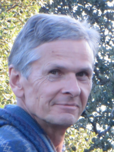
Studies in chemistry. Collaboration at the Carl Gustav Carus Institute with Goetheanistic research on lipids and cholesterol. Work in teacher training in Lima (Peru). Teacher and managing director at Waldorf schools in Germany. Scientific work on the twelve senses. Current research focuses on Rudolf Steiner’s scientific impulse as well as the phenomenology of metals in general and of the rare earth elements in particular. Involvement in the organisational teams of the Natural Science Association within the Anthroposophical Society and of the Chemistry Working Group in the Natural Science Section at the Goetheanum.
The Cognizing Human Being within the Spectrum of Nature
A central motif of Rudolf Steiner’s scientific courses is the human being as a point of reference for a fruitful understanding of nature. He therefore considers how the human being is integrated into the world in a twofold way: through the senses and through the body. Warmth forms a bridge, for we experience it through the sense of warmth and at the same time as active within our own organism. In the so-called Warmth Course, Steiner describes a path in which human being and nature are brought into a unity of cognition. This lecture seeks to retrace this image and to connect it with insights arising from the speaker’s own research.
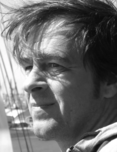
Born in 1966 in Hamburg (Germany). Studies in chemistry with a minor in philosophy, as well as studies in anthroposophy at the Friedrich von Hardenberg Institute for Cultural Studies in Heidelberg. Several years of work for the Anthroposophical Society in Germany, followed by a position as scientific collaborator at the Research Institute at the Goetheanum in Dornach (Switzerland). Since 2006 collaborator at WALA Heilmittel GmbH in the field of basic research. Main areas of work are inorganic raw materials for medicinal products, anthroposophical-pharmaceutical processes, and anthroposophical-Goethean chemistry.
Attempts to Approach the Transformations of Substances
Inorganic as well as plant-based substances can be characterised, from the perspective of the threefold organisation of the human being, in accordance with the tria principia. But what, for example, applies to ash? Is it saline, mercurial, or sulphurous? Even process-oriented, rather than substance-based, characterisations easily lead to contradictions here. Are there, alongside categorical classifications, more concretely descriptive modes of observation through which the physical and etheric forces active in substances and their transformations can be approached?
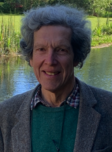
Studies in engineering and subsequent work in particle physics. This was followed by farming in a Camphill community and training in art therapy. He later established a business working with water and the environment, designing and building natural water treatment systems as well as aesthetic water landscapes with Flowform water sculptures. Recent work with holistic science and studies on the path curve geometry in nature. Facilitation of experiential workshops in the UK and internationally. With his wife and an extended household, they manage an old mill site with a large garden, a river and turbines.
The transformative potential of flow phenomena
Indications by Theodor Schwenk, written over 70 years ago, suggest our faculties, especially thinking, can be changed through engaging with flow. We will do experiments live, observe videos and images, and draw on some reported experience of others. We can see archetypal gestures and how they relate to flexible ideas in projective geometry. Does all this attune us to the understanding of life? How this relates to water’s sensitivity may give practical indications for handling water.
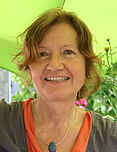
Self-employed biologist and landscape architect, particularly for farms and therapeutic institutions. From 2000 to 2017 responsible for the garden park of the Havelhöhe Clinic in Berlin. Since 2001 member of the board of the European Academy for Landscape Culture Petrarca. Seminar and lecture activities in the field of Goethean-anthroposophical perception and understanding of landscape. www.landschaftsgarten.net, www.petrarca.info
The Atmospheric Quality of a Landscape as a Soul, Spiritual, and Bodily Experience
The experience of the beauty of a landscape can touch us deeply in the feeling of being in harmony with the uniqueness of this place. Yet this immediate impression of a living whole usually fades as the individual details are more precisely distinguished. Is it possible to encounter the sensory appearance in such a way that sensory perception and inner, soul experience unite and interpenetrate within the activity of thinking?

Pharmacist and farmer. Since 2023, co-leader of the Natural Science Section at the Goetheanum. Individual mentoring of students in Goethean botany. Various research projects in Goethean plant studies for pharmacy and medicine. Since 2013, establishment of a production company for food supplements and cosmetics, as well as founding and leading the Association for goetheanistic approach in science “Sapientia” and the Section for Anthroposophical Pharmacy and Medicine in Slovenia. In 2019, takeover of the ecological family farm and Demeter certification.
The Vital and the Astral Stream of the Plant Being in Nature and in the Rising Picture
Every living being fundamentally develops through two opposing processes: becoming and passing. In each plant species, two streams – the vital and the astral – interact with a specific intensity at a particular time in the course of the year. This interplay manifests in the formation of its characteristic temporal body and extends into the physical and chemical realms. The researcher is directly involved in this process of cognition through the senses and through the etheric and soul organization.
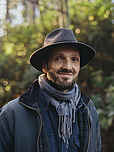
Studies in biology, geography and philosophy. PhD on the chronobiology of mistletoe. Since 2018 living in Scotland, where he works as a course leader, travel guide, researcher and author. Work in research and teaching, with regular publications on questions of perception, the Goethean approach to nature, and anthroposophical epistemic practice.
Before the Separation of Subject and Object – Perception as a Primordial Opening to the World
The human organism is not merely a medium of perception but itself an organ of cognition. Drawing on Goethe, Rudolf Steiner, and Maurice Merleau-Ponty, this lecture unfolds the polarity of perceiving and thinking. The separation of subject and object arises only in thinking; perception initially discloses the world as an undivided unity.
Conversation with Peter Selg
The discussion will be held in German (DE) and translated into English (EN).
Short Presentation & Discussion:
"On the Future of the Anthroposophical Society and its School of Spiritual Science"
Evenings
The evening sessions will be held in German (DE) and simultaneously translated into English (EN) by the session leaders.
Thursday evening, October 8, 2026:
Exploring the Senses on the Red Axis
(You can find more information about the “Red Axis” here.)
Friday evening, October 9, 2026:
A Blind Experiment for Those Who Enjoy Risk
mit Hansjörg Palm
Our diverse sensory instruments are so familiar to us that we often no longer consciously notice or appreciate them. Through practical exploration, we will investigate how precise and reliable sensory perceptions are and how one can reflect upon them: firstly through stations of a sensory parcours, and secondly through a sensory exercise in the open field under “challenging” conditions – participants with a spirit of adventure are warmly invited.
mit Silke Sponheuer & Carolin Schürer
Jede ruhende Form am menschlichen Leib hat ihren Ursprung aus der Bewegung und erwirbt sich ihren Sinn dadurch, dass sie in eine bestimmte Bewegung übergehen kann. Das ist Eurythmie. Sie gibt was aus allen Elementen heraus Leben ist und durch sie empfinden wir unser Hineingestelltsein in den Kosmos. So klärt sie uns darüber auf wie die Tanne spricht, die Quelle spricht… Um den Qualitätenreichtum der Natur zu erleben, müssen wir unseren Organismus in Bewegung bringen. Dies wollen wir gemeinsam, durch Schauen und Bewegen, ins Erleben bringen.
The workshops will be held in the language of the title – without translation.
The workshops are intended to deepen individual topics and questions in smaller groups.
The living experience of the transformation of substances: path from sense to own images of the invisible
In this workshop it will be shown how the experiences with phenomena in the chemistry laboratory awake feelings and intuitions, which, together with the development of imaginative thinking and the construction of concepts, allow students to have a complete scientific preparation. With examples chosen from my experience in school, I will invite you to follow the path that goes from senses to thoughts and to your own images of the invisible.
with Mireia Garcia Viloca
Born in 1972 in Barcelona (Spain). Studies in Chemical Sciences and PhD at the Autonomous University of Barcelona (UAB). Since 2007 Professor at the Autonomous University of Barcelona. Research focus: activation mechanisms of inflammatory resolution processes through membrane protein receptors. Since the 2016/17 academic year involved in the development of the science curriculum at the Waldorf-Steiner School in Bellaterra, teaching chemistry and biology in grades 8–12 and coordinating the science subjects.
Lesen der Steigbildsprache in drei Schritten: Phänomene – Gestik – Harmonie
Die Evolution von bio-chemischen Prozessen von Pflanzensäften im zeitlich gestaffelten Zusammenspiel mit verdünnten, wässrigen Silber- und Eisenlösungen hinterlassen Substanzspuren in und auf Steigbildpapier. Die Auswertenden sind aufgefordert, naturwissenschaftlich exakt, künstlerisch gestaltend und philosophisch erkennend vorzugehen, um die «Aussagen» der Pflanzen mit Augen zu sehen, in sich selbst aufzubauen und zu spiegeln.
Die goetheanistische Naturbetrachtung als Übungsweg zur Ausbildung einer «anschauenden Urteilskraft»
In der «anschauenden Urteilskraft» wird das Denken sehend (anschauendes Denken) und die Sinnesanschauung vernünftig (denkendes Anschauen). Anhand von Übungen an der Pflanzenwelt werden wir konkret und gezielt an der Entwicklung dieses modernen Auffassungsorgans arbeiten. Dabei werden wir einen Weg finden, wie sich dieses Organ im geschulten inneren Umgang mit den Elementen und Ätherarten in uns ausbilden lässt.
Von der Wahrnehmung zum Wesen der Bienen
Ein Bienenstock ist eine unerschöpfliche Quelle von Beobachtungen für alle 12 Sinne. Die Wahrnehmungen rufen seelische Erlebnisse hervor, Staunen, Freude, manchmal auch Furcht und Sorge. Im Besinnen der Beobachtungen und Seelenerlebnisse werden wir vor die Frage gestellt, wie wir den Organismus Bienenvolk in seinem Wesen verstehen können. Und schliesslich werden wir uns mit einer kurzen Textstelle von R.M Rilke beschäftigen, die mit den Worten endet: «Wir sind die Bienen des Unsichtbaren».
mit Johannes Wirz
Geboren 1955 in Thun. Promotion in molekularer Genetik (1987), wissenschaftlicher Mitarbeiter am Forschungsinstitut der Natur-wissenschaftlichen Sektion am Goetheanum, zuletzt Co-Leiter zusammen mit Matthias Rang. Forschungsschwerpunkte: Gesundheit der Honigbienen und Varroatoleranz.
The project presentations are intended to allow you to share current research, book or projects with colleagues through short verbal contributions. Following each presentation there will be opportunity for brief conversation.
The registration deadline was September 20, 2026.
Themes:
Topics for contributions can come from any field of science, Goethean observation of nature, formative forces research, development of research methods, application of research results and science education.
Format:
20 minutes (approximately 15 minutes for presentation and 5 minutes for discussion).
You may hold your research presentation in either German or English (no translation).
Please note that speakers of a project/research presentation have to buy a regular conference ticket.
Ticket sales will be available here starting in mid-June 2026: https://tickets.goetheanum.ch/6HN/
Wolfgang Nefzger
Selbstbeobachtung der Sprachlaut-Bildung und Erkenntnis des Erdorganismus (DE)
Demonstration und Einblick in ein Buchprojekt
15:00 – 15:20 Uhr
Wir beobachten mit Lautsinn, Eigenbewegungssinn und Tastsinn die Abwandlung des Atems zu Blaselauten. Der Luftstrom wird an acht Stellen des Mundraums eingeengt, wodurch charakteristische Durchströmungsarten entstehen. Steigern wir die Einengungen zum Verschluss, so entstehen kurzzeitig stabile Luftformen, die Stosslaute. Als Erkenntnismittel auf den Erdorganismus angewandt bringen die Blaselaute Beziehungen zwischen Erde und Sonne in den Blick, die Stosslaute feste Formbildungen des Erdkörpers.
Moritz Weinbeer
Wie weit lassen sich Pflanzen mit Eurythmie verändern? (DE)
15:20 – 15:40 Uhr
Eurythmie wirkt mit ihren ätherischen Kräften auf Pflanzen. Wir untersuchen in einer mehrjährigen Studie, wie sich diese Kräfte auf die Morphodynamik von 4 Pflanzenarten auswirken, welche Unterschiede die Fluoreszenz-Anregungs-Spektroskopie findet und was ein Geschmackspanel bonitierend beobachtet. Wo zeigt die Eurythmie ihre Wirkung und wo auch nicht? – Erkenntnisse auch für die Pflanzenzüchtung.
Renatus Derbidge
Wald, Waldweide und Offenland (DE)
Die Vera-Hypothese in goetheanisch-phänomenologischer und pädagogischer Perspektive
15:40 – 16:00 Uhr
Ausgehend von der Vera-Hypothese wird untersucht, ob der mitteleuropäische Urwald weniger als geschlossener Wald denn als dynamisches Mosaik aus Wald, Waldweide und Offenland verstanden werden kann. In einer goetheanisch-phänomenologischen Betrachtung erscheinen diese als drei unterschiedliche, aufeinander bezogene Landschaftsgestalten. Ihre Dynamik lässt sich auch in der historischen Kulturlandschaft wiederfinden: im geschlossenen Wald, in halboffenen Streuobstwiesen und dörflichen Landschaftsmosaiken sowie in beweideten Magerrasen und anderen Offenflächen. Die moderne Landnutzung hat diese Gestalten zunehmend voneinander getrennt und funktional vereinseitigt. Vor diesem Hintergrund fragt die Präsentation, wie Menschen die drei Landschaftstypen leiblich und seelisch erfahren und welches Potenzial ihre bewusste Verbindung für die Gestaltung pädagogischer Landschaften besitzt. Die Untersuchung entstand im Kontext eines Forschungsprojekts am Ruskin Mill Centre for Research und wird hier als eigenständige Verdichtung weitergeführt.
Manfred Schleyer
Wie kann das Instrument «Mensch» objektivierbare Ergebnisse liefern? (DE)
Ein Einblick in 20 Jahre Forschung mit Bildekräfteforschung, Tropfbild und Algenuntersuchung
15:00 – 15:20 Uhr
Das Strömungsinstitut arbeitet am Verständnis von Wasser und seiner Qualität. Wir nutzen Tropfbild, Chemie/Mikrobiologie, Süsswasseralgen und Bildekräfteforschung nach D. Schmidt. Seit 20 Jahren setzten wir die Methoden parallel und gewinnen so Ergebnisse sowie Einblicke über Vorteile und Begrenzungen. Die Wirkungssensorik erlaubt die Beobachtung von Aktivitäten im Physischen, Ätherischen, Astralischen sowie Geistigen, liefert so auch Erklärungen der Tätigkeit. Dies soll hier dargestellt werden.
Benjamin Bembé
Life Patterns. Ein Buchprojekt zur Dreigliederung im Lebendigen (DE)
15:20 – 15:40 Uhr
Das vorgestellte Projekt hat das Ziel, ähnliche Strukturen der Dreigliederung bei verschiedenen Organismengruppen darzustellen. Dazu wird derzeit am Institut für Evolutionsbiologie in Witten eine Zusammenstellung fundierter Untersuchungen aus dem Bereich der Gestaltbiologie erarbeitet. Hierfür werden zu verschiedenen Organismengruppen aus dem Tier- und Pflanzenreich Überblicksarbeiten zusammengestellt. Dabei handelt es sich um eine Mischung aus kürzeren, bereits existierenden Arbeiten, Zusammenfassungen von umfangreicheren Themengebieten und neuen Forschungsinhalten. Die Ergebnisse sollen in Buchform sowohl in englischer als auch in deutscher Sprache erscheinen. Die Arbeiten hierzu werden von Benjamin Bembé und Mark Riegner (Arizona) ausgeführt und von weiteren GoetheanistInnen tatkräftig unterstützt.
Alec Schaerer
Spiritualität — durch die Brille der Permakultur betrachtet (DE)
15:40 – 16:00 Uhr
Spiritualität ist eine eigenartig fokussierte Ausrichtung des Bewusstseins auf die im strengen Sinne universell-dynamische Ganzheit, welche je nach Persönlichkeit höchst unterschiedliche Gestalt annehmen kann. Durch den Goetheanismus wird sie nicht greifbar, da sie kein objektiv beobachtbares Phänomen bildet, sondern eine spezielle Form des Selbst-Erlebnisses. Eine Betrachtung durch die Methode der Permakultur bietet sich an, weil diese projekt-orientiert ist, nicht erkenntnis-such-orientiert.
Roselies Gehlig
Spontane Rückbildung von Tumoren (DE)
15:00 – 15:20 Uhr
Die Somatische Mutationstheorie (SMT) fasst die Karzinogenese kausal-reduktionistisch durch irreversible DANN-Zellschäden auf. Diese sind für Krebs aber weder ausreichend noch zwingend nötig. Die Tissue Organization Field Theory (TOFT) betrachtet Krebs als reversible Fehlfunktion der Gewebe, wobei morphogenetische Felder korrigieren können. Spontane Tumor-Rückbildungen sind nicht durch SMT verständlich, besser jedoch durch TOFT und mehr noch im Zusammenwirken der menschlichen Wesensglieder.
Sophie Müller, Tiffany Huber, Viola Heckel & Siegward-M. Elsas
Wirkungen des Hörens von fröhlicher und trauriger Musik auf die Atmung, Herzrhythmus und Gehirnaktivität bei Parkinson-Patienten (DE)
15:20 – 15:40 Uhr
Bei 20 Patienten wurden EEG, EKG- und Atmung aufgezeichnet während Ruhe und beim Hören von fröhlicher und trauriger Musik, gespielt durch eine Therapeutin. Im EEG zeigte sich Aktivierung des präfrontalen Cortex während des Musik-Hörens (p < 0,001). Dies war in der Nachruhe höher als in der Vorruhe, also hielt der Effekt nach dem Ende der Musik an. Fröhliche Musik führte zu schnellerer Atmung und einer Reduktion von HRV (p < 0,001). Insgesamt kam es also zu einer positiven Aktivierung. Insbesondere das Hören von fröhlicher Musik könnte somit bei Depression oder Apathie hilfreich sein.
Carolin Schürer & Matthias Rang
Grundlagenforschung zu den Qualitäten des Metallfarblichts (DE)
Projekt mit Torsten Arncken, Jan-Dirk Monden, Matthias Rang & Carolin Schürer
15:40 – 16:00 Uhr
Im grossen Saal des Goetheanums kann man erleben, wie tief die Wirkung eines farbigen Fensters geht. Marianne Altmaier hat aus dieser Erfahrung eine Metallfarblichttherapie entwickelt. In diesem Projekt werden die dazu eingesetzten Gläser durch Analyse ihrer Substanzen, Farbspektren und der darunter wachsenden Pflanzen charakterisiert. Da die Pflanze als Lebewesen die Wirkung des Metallfarblichts in ihrem Wachstum ausdrücken muss, ermöglicht sie eine Charakterisierung auf ätherischer Ebene. Dies versuchen wir methodisch durch Blattreihen, Fluoreszenz-Anregungsspektroskopie und Symbolisieren des Duftes zu erfassen.
François Lusseyran
Ethology as bifurcation towards a scientific paradigm shift (EN)
15:00 – 15:20 o'clock
“The ecological crisis as a crisis of sensibility”! This is the assertion made the introduction to a book by the scientist Baptiste Morizot entitled Ways of Being Alive (Manières d’être vivant). The author explains: ‘By crisis of sensibility, I mean an impoverishment of what we can feel, perceive and understand' and consequently of what we are willing, as demonstrated by his social commitments. This French researcher is part of a solid international epistemological movement, grouped under the names Environmental Humanities and Multispecies Studies, which has its roots in the awareness and study of a fundamental shift in the nature of ethological research practices that has been gradually evolving since the 1960s. In my view, this amounts to nothing less than the recognition that scientific research practice, even the very act of knowledge itself, can legitimately rely on the entirety of human organization and, for the sake of life, indeed must! That is why, within the framework of this conference, I wish to share a brief description of what might be described as the dawn of a post-Galilean scientific revolution.
Victor Morrow
What did Rudolf Steiner wish to imply when he described the Christmas Conference the “beginning of a world turning point of time”? (EN)
15:20 – 15:40 o'clock
The world picture introduced by Alfred Wegener is considered incomplete by many geologists, and they propose further development, bringing it to a certain wholeness. The possibility will be explored that the foundational heart-impulse towards future Jupiter was soon to be met with on the plane of the historical process by a true morphological world picture of Earth’s origins out of the substance of the Cosmos of Wisdom.
Albina Molina
Peat as a Natural Shielding Material Against Radiofrequency Electromagnetic Exposure (EN)
15:40 – 16:00 o'clock
As wireless technology saturates our environment, Rudolf Steiner warned of electrical currents robbing the human physical body. How can we find a natural counterbalance? This presentation explores a pioneering project bridging empirical physics and Goethean phenomenology to investigate peat (Eriophorum vaginatum) as a protective shield against electromagnetic radiation. Join us to explore how spiritual-scientific observation and material testing unite to harmonize modern technology with natural healing forces.