Robert Wróblewski
In the present study, pigment formation processes involving indigo species, Maya Blue, and plant-derived dyes and toxic plant extracts were investigated experimentally. A central focus was placed on the use of indigo vats (sodium dithionite and fructose vats) as well as on reoxidation processes in order to analyze changes in hue, pigment quality, and material properties.
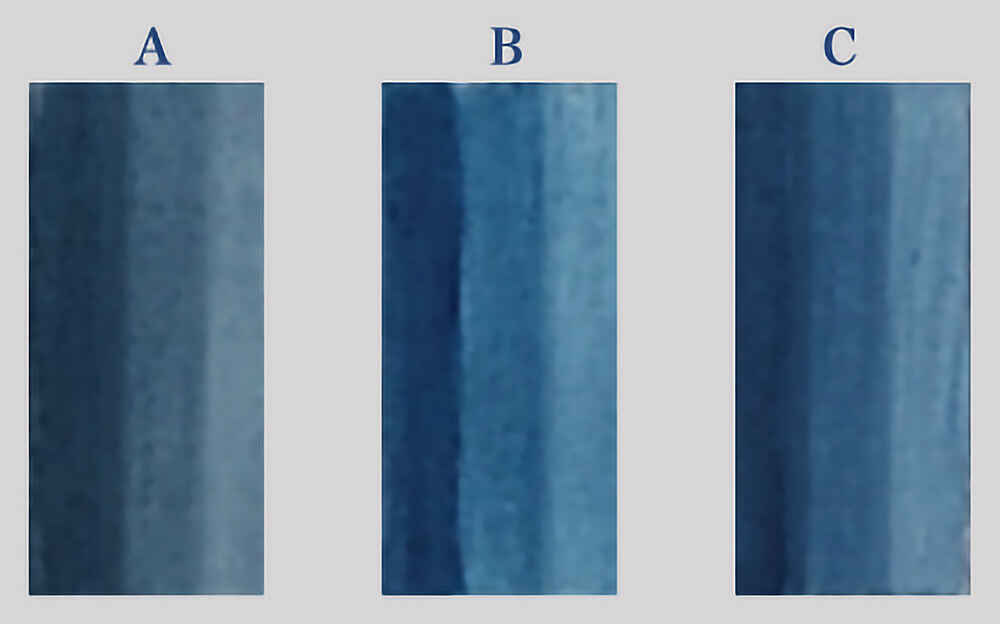
For the investigations, four indigo species from different regions of origin were used (Indigofera tinctoria, Indigofera suffruticosa, Persicaria tinctoria, and Isatis tinctoria). After reduction in the vat, the indigo was deliberately reoxidized and precipitated as a pigment. It was observed that all indigo species showed a greyish tint after reoxidation, while Indian and Mexican indigo appeared overall more bluish. Isatis tinctoria showed the lowest colour strength in comparison. Reoxidation not only led to changes in hue but also to a change in pigment quality: the pigments became finer, more transparent (glazing), and appeared optically more luminous.
In parallel, the preparation of Maya Blue was investigated. Indigo from the vat was combined with attapulgite and dried under controlled conditions. The Maya Blue pigments produced from the vat showed lighter, slightly greener blue tones compared with the classical dry method and required lower temperatures.
Another focus lay on the targeted addition of diluted toxic plant extracts (including Digitalis purpurea, Colchicum autumnale, and Atropa belladonna) at different stages of pigment production from Reseda luteola and Rubia tinctorum: during extraction, during precipitation, and after precipitation (ageing). The toxic plant extracts were serially diluted in decimal steps (10⁻¹–10⁻⁴) and applied without succussion. Their influence on hue, pigment formation, and sedimentation behaviour was investigated.
The results show that both the type of indigo and the type of vat influence the colour properties and material qualities of plant pigments during the reoxidation process and in the production of Maya Blue.
Mixtures of plant toxins with plant dyes have so far shown no significant changes. At high dilution (around 10⁻⁸), a slight change in lightfastness appears to emerge. However, this still needs to be further verified.
In addition to simple dilution, proper potentization should also be tested.
Or via Bank Transfer:
| CHF | EUR | |
| Allgemeine Anthroposophische Gesellschaft Postfach, 4143 Dornach/Schweiz Raiffeisenbank Dornach, CH–4143 Dornach BIC: RAIFCH22 IBAN: CH54 8080 8001 1975 4658 2 ⇨ Payment Purpose: KST 1118 | Allgemeine Anthroposophische Gesellschaft Postfach, 4143 Dornach/Schweiz GLS Gemeinschaftsbank eG, DE-44708 Bochum BIC: GENODEM1GLS IBAN: DE53 4306 0967 0000 9881 00 ⇨ Payment Purpose: KST 1118 |