Philipp Bokatius, Gudrun Mende, Matthias Rang, Peter Stolz, Jenifer Wohlers
In the second year of this five-year research project, conducted by the KWALIS Research Institute in cooperation with the Natural Science Section, the focus was on measurement series using the method of Fluorescence Excitation Spectroscopy (FAS), which could be successfully carried out with samples provided by practice partners. Additional sample series relevant to the research topic were included, and further measurements were conducted, particularly on the ripening of fruits and vegetables.
Foundations of the Quality Concept Using Ripeness as an Example
The light measured in FAS is emitted by the sample as a result of a light metabolism: the sample absorbs light and emits light due to internal physiological processes. The intrinsic colour of the sample also plays a role in this process. In order to study the phenomenon of ripeness in relation to the intrinsic colour of the samples, ripening series of raspberries and grapes (both light and red varieties) were prepared. The ripening series of raspberries clearly showed an increasing yellow dominance and broadband character of the emitted light during ripening, as well as a decreasing yellow dominance in cases of overripeness and spoilage. This effect was clearly visible, independent of colour variations of the berries, and in agreement with similar previous observations. This demonstrated how, alongside purely physical colour effects, ripeness-related factors also shape the fluorescence properties of the samples.
Plant Physiology: Plants Grown Under Coloured Light
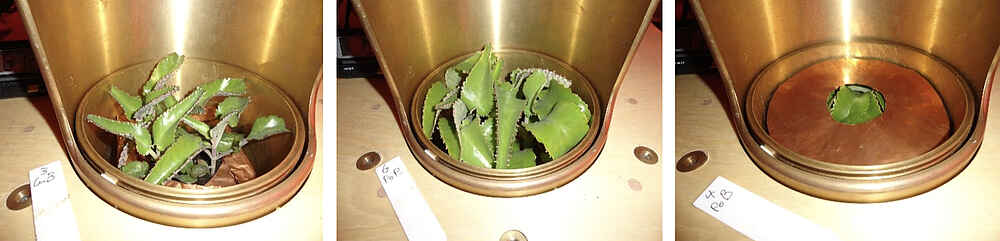
For the first time, we also investigated entire plants using FAS, originating from the project “Anthroposophical Metal Colour Light Therapy: Fundamental Research on the Qualities of Metal Colour Light.” The measurement of whole, living plants proved to be challenging, as they had to stand rather confined within the measurement chamber and the measurement conditions were therefore difficult to standardize.
To ensure measurement reliability, an additional size-standardized measurement of leaves using a perforated plate was carried out. In two measurement series it became evident that coloured light treatment during the growth phase influenced the plants not only morphologically but also in their light metabolism. In the measurement series involving metal-coloured light glasses, this effect was particularly visible after blue excitation.
It was also tentatively possible to distinguish whether the plants had been cultivated under metal-coloured light glasses or under polymer films of the same colour, although further investigations are required here.
The yellow–blue ratio has been a proven parameter since the early days of FAS about three decades ago for distinguishing whether a sample shows a vegetative or regenerative character. A tendency could be observed in this parameter that corresponded with the morphology of the plants: Plants grown under green light showed similarities, in Bryophyllum, to those grown under colourless conditions. By contrast, plants grown under blue or red coloured light exhibited more strongly deviating values. The yellow–blue ratio may therefore also contribute to the characterisation of cool and warm light colours during plant cultivation. The inclusion of other plant species is still pending, and further investigations are planned for the coming year following renewed cultivation.
Or via Bank Transfer:
| CHF | EUR | |
| Allgemeine Anthroposophische Gesellschaft Postfach, 4143 Dornach/Schweiz Raiffeisenbank Dornach, CH–4143 Dornach BIC: RAIFCH22 IBAN: CH54 8080 8001 1975 4658 2 ⇨ Payment Purpose: KST 1111 | Allgemeine Anthroposophische Gesellschaft Postfach, 4143 Dornach/Schweiz GLS Gemeinschaftsbank eG, DE-44708 Bochum BIC: GENODEM1GLS IBAN: DE53 4306 0967 0000 9881 00 ⇨ Payment Purpose: KST 1111 |